
Updated after nearly 10 years of real-life use in our family kitchen.
When we decided on wood countertops for our DIY kitchen remodel, I did so much research on sealing butcher block. I was concerned wood counters would be high maintenance and get stained easily. I wanted to naturally darken the IKEA butcher block we purchased to look more farmhouse rustic, and I wanted a finish that was completely food safe. Post may contain affiliate links.
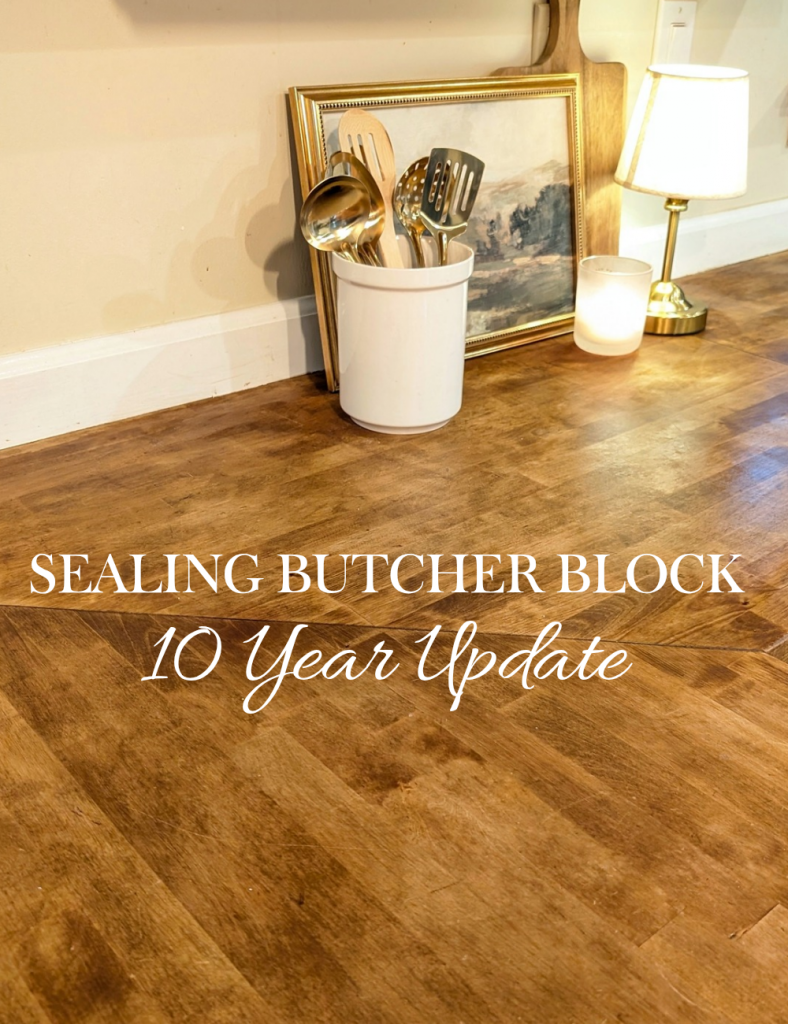
The finish that met all our needs was dark tung oil.
When I first wrote this post, we were about two years into living with these counters. Now it has been almost ten years…and I can give a much more complete picture of how sealing butcher block with tung oil actually holds up in a busy family kitchen.
Spoiler: they are not pristine. But they have held up beautifully.
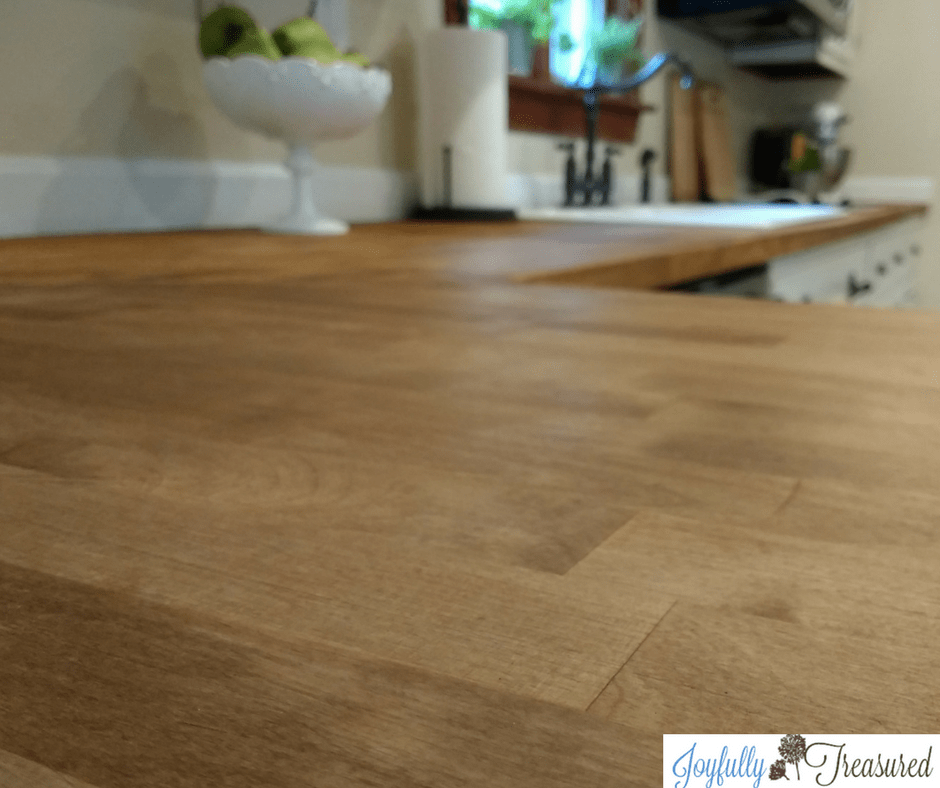
Why I Chose Dark Tung Oil for Sealing Butcher Block
The dark tung oil I used from Real Milk Paint beautifully darkened the IKEA butcher block and gave it that rustic farmhouse warmth I was after.
What I still love about it 10 years later:
- Food safe once cured
- Naturally darkens wood without looking painted
- Dries to a matte finish (not shiny or plasticky)
- Cures hard instead of staying oily
- Can be sanded and reapplied if damaged
- Extremely low long-term maintenance
If you are starting from scratch today and installing new butcher block, I would absolutely recommend using solid wood rather than veneer so the oil can properly penetrate and be refinished over time. Solid birch butcher block countertops absorb tung oil beautifully and can be sanded and resealed for years.
Materials Needed for Sealing Butcher Block with Tung Oil
- Dark Tung Oil (I used 32 oz for our kitchen)
- Citrus Solvent
- Rags and rubber gloves
- Sander (optional)
- Disposable container
If you are sealing butcher block before installation, I highly recommend sealing the underside as well to prevent uneven moisture absorption.
Should You Sand Butcher Block Before Sealing?
On one side of the kitchen, I lightly sanded the entire surface before applying the tung oil. On the other side, it was one simple slab and I oiled it just as it came out of the box.
I definitely felt that the oil soaked up faster on the sanded side and that side still has slightly more color variation today.
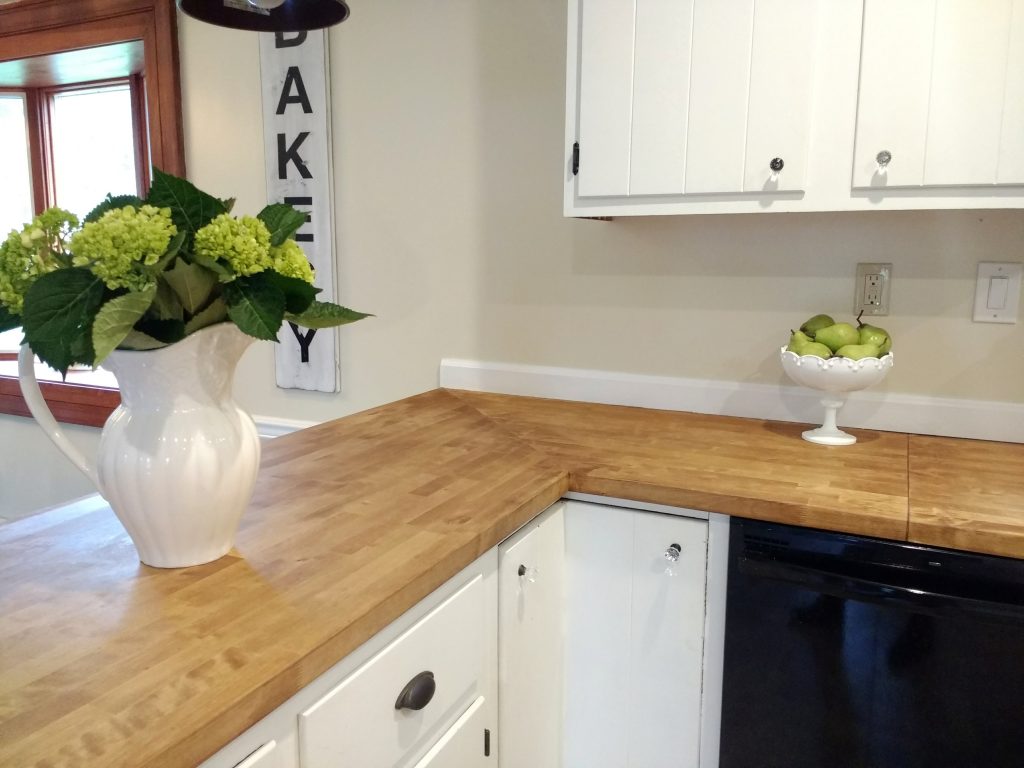
This is the unsanded side for comparison:
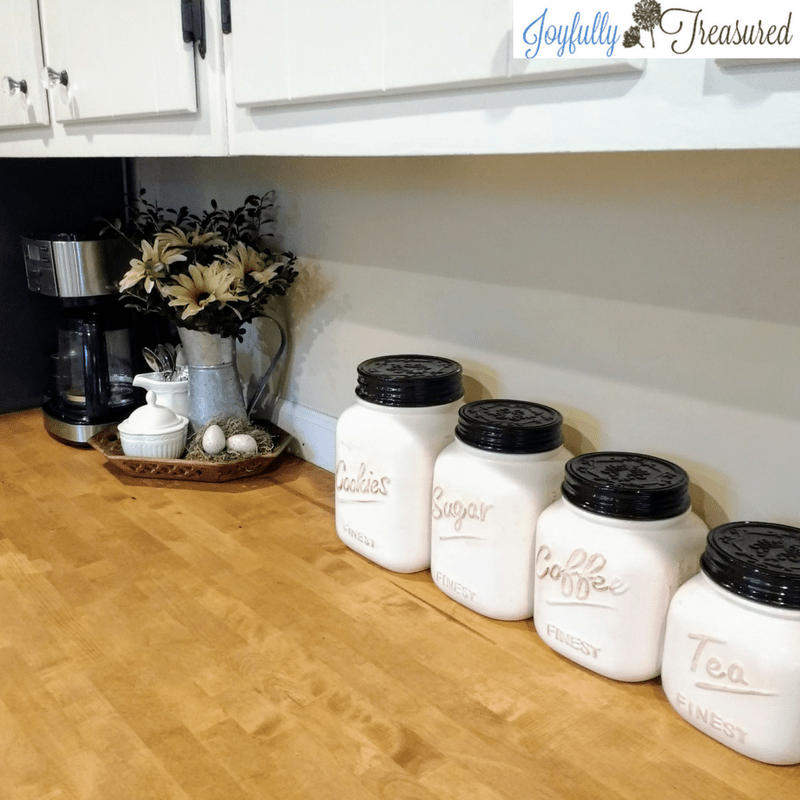
If I were doing it again, I would lightly sand everything before sealing butcher block. It helps with even absorption and gives you more control over the final tone.
Step-by-Step: How I Sealed Our Butcher Block Countertops
1. Seal the Underside First
Before installation, I applied one coat to the underside because I read that sealing both sides helps prevent warping.
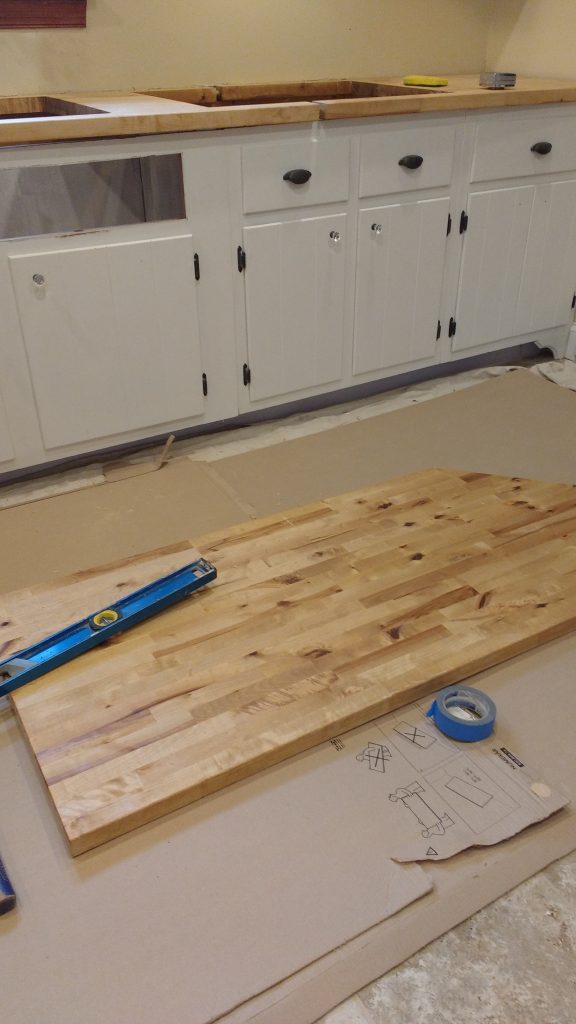
2. Mix Tung Oil and Solvent (50/50)
To apply, mix the tung oil 50/50 with citrus solvent. A solvent is necessary to help the oil penetrate the butcher block. You can also purchase “Dark Half” as well, which is already mixed with the solvent and ready to go!
Mineral spirits is another solvent option that is locally available, but it is not food safe while it is evaporating. Plus, citrus solvent has a way better aroma than mineral spirits!
3. Apply Generously
With gloves, I applied the mixture to the counters with a rag, then let it sit on the counters for about an hour so the oil can soak in.
4. Wipe Off Excess
After about an hour, wipe off any visible excess oil with a clean rag.
Note: Don’t leave visible excess oil for days at a time, because it cures hard and you might have streaks. If this happens though, you can always sand a bit and reapply. (Lesson learned!… I oiled another coat on ours right before a week vacation and I had a spot to fix when we came home.)
5. Repeat Until Saturated
I waited a day or two in between coats to let the oil start to sink in. Once the butcher block is completely saturated, water will bead up on the surface.
The oil dries to the touch in about a week, and fully cures in about two.
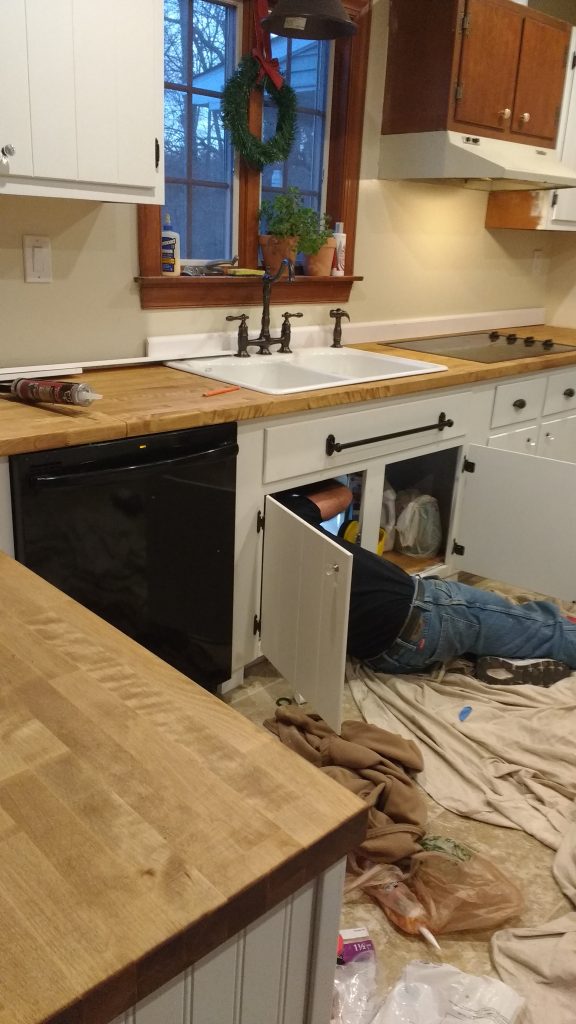
Tung oil cures to a smooth hard finish. The counter is safe to use right away, just don’t leave papers on it that first week until it dries or they may absorb some of the oil. It was a really simple application, which was a mercy for me after the exhausting job of painting the kitchen cabinets! This is a photo of the countertops after one heavy coat.
What Our Butcher Block Looked Like After 2 Years
After the initial coats of dark tung oil, the counters had the rustic matte finish I loved.
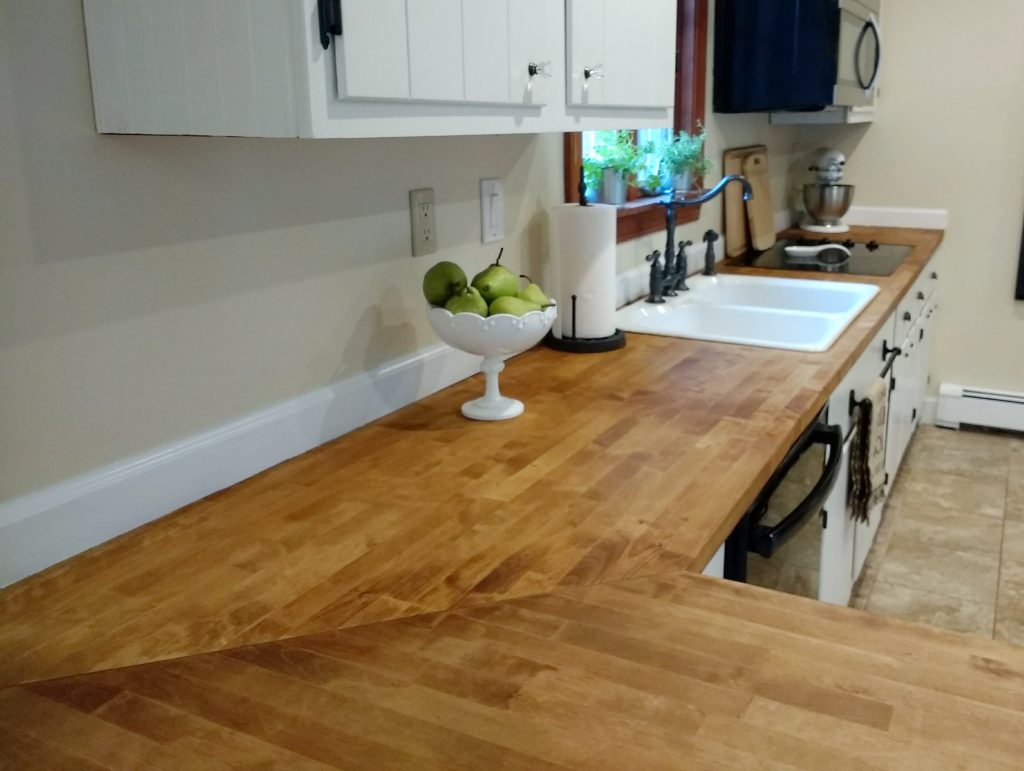
At the two-year mark:
- Water beaded beautifully
- Stains wiped right off
- Very little maintenance required
- No oily residue once cured
At that point, I had only applied one light maintenance coat using clear tung oil.
10-Year Update: How Our Tung Oil Butcher Block Has Really Held Up
Now for the honest part.
It has been almost ten years since sealing our butcher block countertops with dark tung oil.
They do not look brand new, and I would not expect them to!
We are hard on our kitchen. We cook daily. We have kids. There have been coffee drips, food splashes, arts and crafts messes, and years of normal family life happening on these counters.
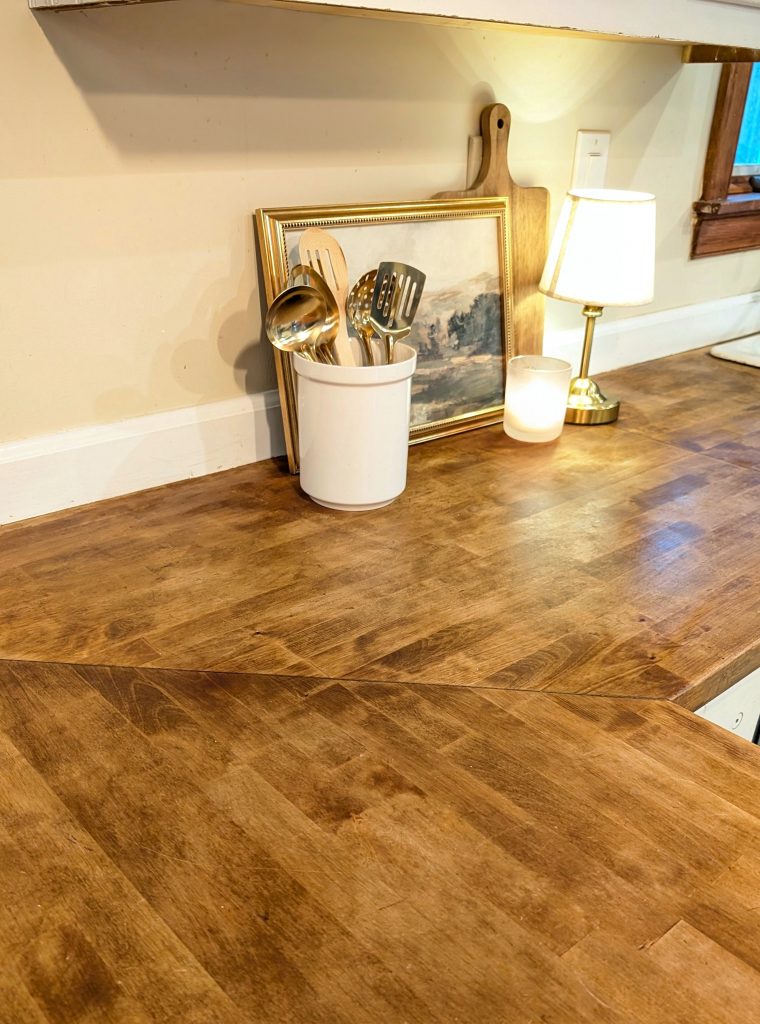
Here’s what I can say confidently:
Surface Wear
- There are small scratches and signs of use.
- The wood has developed a deeper patina over time.
- It looks lived-in, not damaged.
The beauty of sealing butcher block with tung oil is that it doesn’t peel or chip like a film finish. It wears naturally with the wood. (Even with almost zero maintenance like in our case!)
Water Resistance
Even around the sink area, we have not had warping or swelling issues. Because we sealed the underside and allowed the oil to fully cure, moisture has never been a major issue.
Water still beads when freshly resealed.
Maintenance Over a Decade
In ten years, I have resealed them 3 times.
That’s it. Which I realize is far less than recommended in a decade.
And those were not full strip-down refinishes, just light sanding in high-wear areas and reapplication.
For a high-use family kitchen, that is extremely low maintenance.
We would not get that kind of mileage from mineral oil finishes, which require frequent reapplication and never cure hard.
Tung Oil vs Mineral Oil vs Waterlox
When deciding on sealing butcher block, I considered all three.
Tung Oil
- Food safe once cured
- Cures to a hard, matte finish
- Repairable and refinishable
- Very low long-term maintenance
Mineral Oil
- Food safe
- Does not cure hard
- Requires frequent reapplication
- More ongoing maintenance
Waterlox
- Creates more of a protective film
- More sheen
- Harder to spot repair
For our lifestyle, tung oil has felt like the best balance of durability, repairability, and natural look.
How Often Are You Supposed to Reseal Tung Oil?
Here’s the honest answer.
When sealing butcher block with tung oil, the recommendation is applying a maintenance coat about once a year…especially in high-use kitchens.
The general rule is simple:
If water stops beading and starts soaking into the wood quickly, it’s time to reapply.
Now here’s our reality.
I originally planned to reseal ours once a year. Maybe even every six months around the sink.
That did not happen.
Life gets busy. Kids, cooking, normal chaos… resealing countertops was not high on my priority list.
In almost ten years, I’ve resealed them about 3 times total.
Would they look even better if I had done it yearly? Probably.
But here’s what surprised me: even with that neglect, they have held up well.
That’s one of the biggest advantages of sealing butcher block with tung oil. It cures into a durable finish that doesn’t immediately fail if you miss a maintenance year. It wears gradually and can always be refreshed.
If you want them to look as close to new as possible, plan on a light maintenance coat annually.
If you’re like me and miss a year (or years!)? They’re still going to be okay…and you can sand and refresh when you’re ready.
FAQs About Sealing Butcher Block
Is dark tung oil food safe?
Yes, once fully cured if using mineral spirits. The curing process takes about two weeks.
How many coats of tung oil does butcher block need?
Apply coats until the wood stops absorbing oil and water beads on the surface.
Do you have to sand before sealing?
It is not mandatory, but light sanding improves absorption and color consistency.
Does tung oil waterproof butcher block?
It makes it highly water resistant once cured, but no wood surface is 100% waterproof.
How long does tung oil last on countertops?
In our kitchen, with heavy use, we’ve resealed only 3 times in ten years.
Final Thoughts on Sealing Butcher Block
I was nervous about choosing the right finish for our wood countertops. I worried the countertops would stain easily or require constant maintenance.
Almost ten years later, I would absolutely do it again.
Sealing butcher block with dark tung oil gave us the warm, rustic look I wanted, and the durability to live real life in our kitchen without babying the counters.
If something does damage the surface, it can be sanded and refinished. That’s the advantage of solid wood.
If you’re installing butcher block today, choose solid wood, seal both sides, and allow proper cure time. It’s a decision that can last a decade.
Check out this post for a safe natural cleaner for butcher block. Or, you can click here to read more about our kitchen remodel!
Related posts:
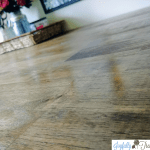 Finishing Butcher Block with Wood Bowl Finish, A Dark Walnut Stain for the Craft Table
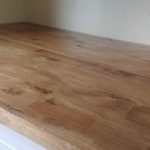 DIY Butcher Block Countertop, $100 Room Challenge Week 2
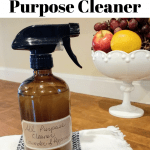 DIY Natural All Purpose Cleaner with Lavender and Peppermint, How to Clean Butcher Block Countertops Naturally
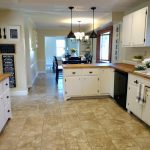 Our DIY Kitchen Remodel Before and After, Tackling a Farmhouse Kitchen Makeover on a Budget: Part 1
So beautiful! Thanks for sharing on To Grandma’s House We Go!
What do you use to clean your counters throuout the day? Btw the kitchen is beautiful.
Thanks Kim! 🙂 To clean our counters, I use plain dish soap and water, Clorox wipes, or an essential oil vinegar cleaning spray. Thankfully tung oil finish is pretty tough, so I haven’t had any problems with cleaning.
These are beautiful and we are also considering the Ikea butcher block for our DIY kitchen remodel! Can you share any insight on how you installed your counters? It looks like our kitchen layout is similar to yours. Specifically, how did you handle the seams between slabs?
Hi Kayla! Thank you so much! We used the Ikea hardware to attach the butcher block to the cabinets. We had help with the cutting that wasn’t in a straight line. I was so afraid to mess that part up! I tried both wood glue and sawdust, and wood filler and sawdust. I preferred the look of the wood filler mixed with sawdust to fill the cracks. It blended more seamlessly. Both worked great as far as sealing though! We sanded lightly until smooth after the joints dried. I hope that helps. 🙂
I love your countertops! I have always loved butcher block counters. We plan to install them in our new house once we move in, and are installing pine floors as well. We plan to use tung oil on the counters as well as the floor. Will let you know how it turns out. I love tung oil, and used it on a butcher block table I sanded and refinished – looks so beautiful 🙂 We also plan to use it to seal our cedar deck once it is built.
Great job on your kitchen! Thanks for sharing.
Hello Molly!
Thank you so much. I never knew tung oil was great for floors and decking! I would love to hear how they turn out! 🙂
I finished my butcher block counter top as you described, it has been 3 weeks of use after the curing time and it is already looking dull and wearing. Any insight on what I did wrong?
Hi Lindsay!
I am so sorry the finish is giving you trouble. I am wondering if you used enough coats of the finish initially? It is not a high gloss finish in general. Does it seem uniformly dull, or just in certain spots? How is it wearing exactly? I do remember initially the finish looked dull in spots where the counter soaked up the oil unevenly and still needed more. It took several coats for the initial application. I hope this helps! You might also reach out to Real Milk Paint for more suggestions!
Lindsay did the problem resolve as I am trying to decide how to finish my top
Pingback: Our DIY Kitchen Remodel Before and After, Tackling a Farmhouse Kitchen Makeover on a Budget: Part 1 - Joyfully Treasured
Beautiful. Thanks for all the tips!
Lovely job! Am curious; is your Ikea butcher block solid or is it the quarter inch laminate? We installed the walnut laminate in our pool house kitchenette and love it, but it doesn’t get daily use by any means. After our first guests were there, we did find water ring marks, but I used mayonaise and the white spots came right out. Have been trying to decide if I should go ahead and treat with the tung oil. Thanks!
It is the old solid wood kind, but I believe the new laminate type is still real wood exterior for that 1/4″. If so, it can be treated just like regular butcher block! You don’t have to sand first, and it protects the wood so it will be easier to clean. 🙂
This looks like something I want to try can this be done to laminate counters.
If the countertop has a real wood exterior, it can! For example, the Ikea butcher block that has a lightweight core, with 1/4″ real wood exterior.
That looks beautiful in your kitchen. How old is your house? I live in a farmhouse that was built in 1901.We have remodeled some areas of the house, but have a lot more to go. My husband put granite in our kitchen, but it just doesn’t look right for that period of house. I love the butcher block look. Thank you for sharing.
Thank you , Christine! Our home was built in 1962. I agree, butcher block is perfect for an old farmhouse! I love old homes too. We looked at several old farmhouses on our house search, but to fit in our budget they all sadly needed more work then we could manage. This home was all original, but mostly cosmetic changes. 🙂
Your countertops are beautiful! How many coats did you apply total? Did you sand in between coats? Also how much drying time in between coats?
Thanks in advance!
Hi Kelly! I believe I initially applied 4 coats total, until I didn’t see any dry spots left in the wood. I only waited a day or two in between the first few coats when the wood was absorbing the oil easily. Then I applied another coat after the oil was nearly dry, about 10 days later I believe. I hope this helps! 🙂
You have the exact countertop color I’ve been trying to achieve! I have a birch BB countertop and used Milk Paint dark Tung Oil mixture (6 coats) but mine are super orangey and not smooth. Is your countertop birch? When you originally used dark Tung Oil, were they orangey?
Yes, we also have the Ikea Numerar birch! They were definitely more orangey on the side we didn’t sand. The color deepened more over time. We did about 4-5 coats initially.
Doing a thorough sanding with a palm sander first really seemed to help the stain absorb further to get a deeper color.
I remember if I left any oil sitting on the surface, it would dry hard and not be smooth. Very light coats worked best. Any rough spots can always be sanded out though, that’s what I love about butcher block! 🙂
A friend of mine just made us a butcher block top for our kitchen island. It’s small (25 1/2″ x 42″) and he used pine. I wish he had used a hardwood, but when it’s free you accept it as a blessing. Anyway, There isn’t much differential in any of the wood planks as far as color goes, but I’m hoping that once I begin the sealing process that some will be noticeable. Would you recommend using the Dark Tung Oil/Orange Citrus on pine? It’s really light colored and we want it darker. I’m going to be making cinnamon rolls on this surface, so hope it holds up and doesn’t stain from the cinnamon/butter, etc. Thank you for your input.
I think the Tung oil would work fine, and certainly darken the wood! I am not sure if it would add any variation, but it would definitely work well as a sealer. I use ours pretty often, and sometimes roll out dough on top and I never had any issues!
Pingback: DIY Natural All Purpose Cleaner with Lavender and Peppermint, How to Clean Butcher Block Countertops Safely - Joyfully Treasured
I know this is an older post but I was wondering how many coats of the dark tung oil did you apply? You’re countertops are beautiful!
Hello Whitney!
Thank you so much! I believe it was 4 coats initially. I did one more coat recently as a maintenance coat. If I remember correctly, I applied two coats two days in a row, then another couple coats a few days to a week apart after the oil was nearly dry. You could see where it needed more each time. By the last coat, the appearance was very smooth, and water beaded on the surface. 🙂 I hope that helps!
Thank you for this post! We’re considering butcher block and I really want a non-toxic finish, so this was very helpful!
Did you apply the last coats after the sink and stove top and sink was installed?
Yes, I did! The oil cleans up fine on the sink and stove, it can be a bit messy though! I try to be careful near the white trim on the edge against the wall.
We used the tung oil and citrus solvent after reading your blog and a few others. I love the antique finish it’s given us but it’s not sealing like it’s supposed to! It seems to just keep soaking into the wood no matter how many coats I put on it. I think maybe we’ve used it too much before it was really dried and we rubbed off the oil? Did you use your counters before they were cured? Any suggestions would be very much appreciated! We’ve had the most trouble around the sink – it’s definitely not a water barrier yet. It’s been almost 3 weeks since we started the oiling process and 1 full week since i did what i thought was going to be the last coat and it’s not what I was expecting.
Hi Abby!
Im so sorry the tung oil isn’t curing right!
The tung oil took about a week to 10 days to cure. Until it dries out, it feels tacky and oily. I did use the counters, but tried to as little as possible while curing.
I’m not sure if this made any difference, but I also let the oil sit really thick on the countertops for a few hours or overnight before i wiped off the extra to try to let it absorn as much as possible.
Are you using it 50/50 with the citrus solvent? The solvent helps it penetrate the wood. What type of wood is your butcher block?
Also, try to reach out to Real Milk Paint too. They probably have lots of tips to help!
Hi, I love your color. I purchased a butcher block from hoods. It looks like a birch color. I want them to be similar to your color, but some of the dark Tung oil I’ve seen are too dark. I wasn’t this tone or lighter. Not yellowish. Do you recommend the dark Tung oil or pure Tung oil. Any tips? Looks like sanding first might help too? Thank you.
Hello Amanda,
Do you have a small scrap piece to try it out? The dark tung oil I used looks very dark brown out of the bottle, but it just tinted the butcher block to the dark golden finish we ended up with. If you are looking for a finish similar to ours, I highly recommend the dark tung oil. 🙂 See if you can try it out on a scrap piece, or the underside first to make sure you love the color!
We just bought the stock, unfinished butcher block countertops from Lowe’s, and I’m super excited! I love the color of your countertops, in the pics you posted they don’t appear too, too dark… but another user posted a pic and hers appeared much darker, they looked nice, but I want to stay on the lighter side. Any thoughts/suggestions? Thanks!!
Hi Jocie!
Yay for new countertops!
The more coats I applied, the deeper the finish gets. So I’d recommend applying the dark oil until you get the color you want, then clear tung oil after.
It can also depend on the type of wood. Our counters are birch, which is a pretty light tone unfinished. I hope that helps! 🙂
Quick question, did you ever sand in between applying your coats of Tung Oil or just apply the finish straight on? I purchased Birch butcher block from Lowe’s also 🙂 I plan on ordering Real Milk’s Dark Half so I do not need to mix the Tung oil and solvent.
I did not sand in between coats initially. Just right before the first coat.
I love how the dark half is pre mixed. I hope your counters come out amazing! 🙂
Hello! Are you hard on your counter tops? Do you prepare food directly on top or do you use a cutting board? Thanks!
Hello! It’s a mixture. 🙂 I often use a cutting board, like while preparing dinner or doing lots of chopping. However, I also frequently cut or prepare food on them directly for lunches and quick slicing.
Pingback: Finishing Butcher Block with Wood Bowl Finish, Dark Walnut Stain and a Non-Toxic Finish - Joyfully Treasured
What do you use to clean off the butcher block counter? Just a wet watered cloth? Should we avoid using sanitizing wipes? we are considering using butcher block but it’s a first time experience with it. Is it ok to stain the wood with the red-brown color we want before applying the tung oil?
Hi Melody! I use clorox wipes all the time, and a homemade castile cleaner for the post-meal wipe downs. Here is the quick tutorial for the cleaner.
Lavender Peppermint Castile Cleaner
I am not sure about staining the wood before adding the tung oil, since stain is helping to seal the wood, and you want the oil to soak in and protect it. You might try staining and doing a wood bowl finish. That is an option we looked at before going with the tung oil because it is also food safe if not used as a chopping board.
Finishing Butcher Block with Wood Bowl Finish, A Dark Walnut Stain
Pingback: $100 Room Challenge: Powder Room Reveal - Joyfully Treasured
The end result is beautiful! I have Ikea butcher block and have applied mineral oil, but have not reapplied for six months or so, can I apply the dark tung oil on the countertops now?
Thank you so much Connie!
I would say yes! They are probably plenty dry, and the solvent helps the oil penetrate into the wood.
Thank you for this tutorial. How many coats do you think you did on the top? Did you sand between coats?
Hello Ginna,
I did 4 or 5 coats total, with no sanding in between. Most of the kitchen area was sanded initially during install, and the countertop coloring I think looks deeper in the areas that were sanded!
Hello ,
I was wonder what kind of wood these counter tops are?
I am getting ready to seal an island counter that is birch so I was curious if yours were tbe same kind of wood?
Thank you 🙂
Yes, it is! Ours are birch ikea Numerar!
Hey I hope you’re doing well! Your countertops look absolutely beautiful.
My husband and I are renovating our kitchen and just bought some burch butcher block for our kitchen counters. I would love for them to look like yours! Did you use the whole container of the 32oz dark tung oil? I was just thinking that it seems like a lot, but I’ve never used it before. How many coats of dark tung oil would you recommend? We probably have the same amount of counter space as you do. And do you only use the clear tung oil for maintenance or do you apply it in the initial process too after the dark tung oil?
So sorry for the MANY questions! I just LOVE yours!
I’m so sorry, I just realized many of my questions have already been answered in previous questions!
Hi Megan! Thank you so much! I did not use the entire bottle initially, although I did use most of it! I finished off the bottle of the dark with the first maintenance coat, now I have moved on to the clear tung oil for maintenance. 🙂
Is this okay to do over stain and epoxy?
Hello! I am not sure it would work, as the epoxy would not allow the finish to penetrate into the wood.
I also decided to use The Real Milk Paint Co. Tung Oil and found they have one pre-mixed, called half & half with Citrus Solvent. I’m sitting here letting the 3rd application soak in as much as it can before wiping with a clean cloth. So far I’m impressed and I’m so happy I found your information. I feel like I’ve chosen well. Thank you!
I am so glad to hear it is working well for you so far, Jerae! Thank you so much for sharing your experience! 🙂
Hello! Are you hard on your counter tops? Do you prepare food directly on top or do you use a cutting board? Thanks!
Hi, Did you use full strength for your final coat, or always 50%?
Hello Dawn! I used 50 percent strength for every coat. The solvent evaporates completely as it cures, so you are just left with the oil. 🙂
what should i use for sealer for under so it wont warped
Hello Madeleine,
I used one coat of Tung oil on the underside prior to installing. 🙂
Have you noticed if your counters have darkened over time? I used dark tung oil on my island and was hoping for darker finish- but was maybe hoping it would happen naturally like I’ve heard?
Hello Susan! They did darken slightly over time. Another thing I noticed was sanding first gave better absorption and a darker finish. The color also builds slightly with each application. Once you reach the color you want, you can switch to clear tung oil for maintenance.
Pingback: Adventures in Staining Butcher Block - What worked and what didn't
I’m using Real Milk Paint 50/50 with citrus solvent and my counters are maple. I applied the second coat 2 days ago and it’s still pretty wet. I wipes it with a clean rag but it’s still wet. Should I still go ahead with another coat now or wait?
Hello Samantha!
I’m sorry this reply took a few days! You can apply another coat while it’s still damp. For our counters, it takes a solid week to completely dry. I only waited about a day in between coats, to let the oil absorb into the dry spots.
Hi! I am trying this and I came out to do the 2nd coat, and there’s like foggy spots. Almost like I tried to whitewash but not to that extreme. Any idea what this is??
Hmmm…that sounds odd! There are often “dull spots” after the first coat where the oil completely absorbed and still needs more. I wonder if this is what you are describing? Depending on the type of wood the countertops are made of, I imagine it could look slightly different than mine did. I hope this helps! Hopefully it will all darken evenly with the next couple coats.
How long after putting a coat underneath till you installed
Hello Christine! It was just a few hours if I remember correctly. Not long at all. Just long enough so the underside was not too wet when we placed it on the top of the cabinets.
How much of the tung oil did you use per ft2 of countertop? Just curious how much to buy.
Hello, I am not sure exactly how much I used per square foot, but I purchased the 32 oz bottle of the dark for our entire kitchen, and had a small bit left at the end! For the half and half where it is pre-mixed, that would be 64 oz size.
Hi! Love your countertops. We just bought butcher block for our island and I’ve ordered the Milk Paint half/half dark tung oil My question is, how will humditiy affect the drying? Were in North TX where it is very humid and I will be applying the tung oil in the garage before we bring it in. Do you think it will take much longer for it to dry/cure? Thank you for your help.
I do believe the humidity will extend the drying time a bit. Even without being fully cured yet, they are completely safe to use! They just feel slightly oily while they are curing, and things like papers laying on them may absorb some oil.
Our counters were actually installed in winter, so I can’t say exactly how much longer it may be to dry!
Do you put the tung oil on the top, bottom and all sides before install?
Hello! I did do one coat before on mostly just the bottom before installing, as I read that it prevents warping.
You said to saturate it. I just used it on a rag and put it on then wiped it. Does it have to be a lot on the counter when applied?
Hello Dodi! I just applied enough that there is a bit sitting on top wet, and let it soak in, as the fresh butcher block soaks up the oil a lot at first! Several thin coats works well also!
Do you know what type of wood your butcher block is? Trying to decide which wood type to go with and I am liking the tones of yours.
Hi Hannah, this is birch butcher block!